
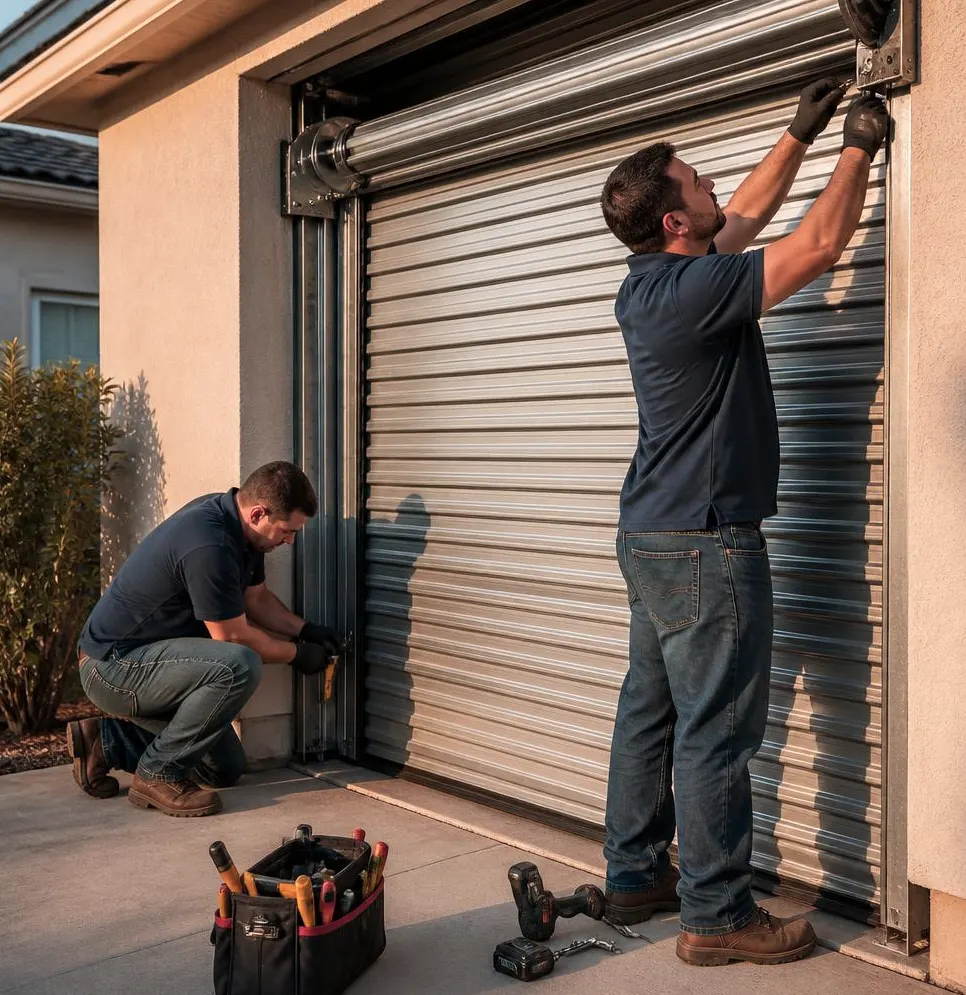
The Night the Door Started Bowing
You hear it before you see it: a low rattle, then a hard gust that makes the whole door flex inward with a dull boom, like the house just took a punch. You flip on the garage light and watch the panels ripple slightly with each wind push, the tracks shivering in their brackets. Maybe there's a thin line of daylight — or streetlight — along the bottom edge that wasn't there last month. That's the moment most homeowners realize their garage door isn't just a big door. It's acting like a wall, and it's not built like one.
Why the Garage Door Is Your Home's Weakest Wall
Every other wall in your house is a solid, continuous structure tied into studs, sheathing, and a foundation. The garage door opening is the single largest gap in that envelope — often nine or sixteen feet wide — held together by a thin metal or composite panel, a set of rollers riding in lightweight tracks, and springs doing all the heavy lifting. When wind hits the front of a house, pressure builds against that door like air against a sail. If the door fails, wind can push into the garage, pressurize the whole house from the inside, and put stress on the roof structure it was never designed to handle. That's why building codes in high-wind regions treat garage doors as structural components, not just an appliance you open with a clicker.
What Storms Actually Do to a Garage Door
Solano County doesn't get hurricanes, but the wind events that move through the Carquinez Strait corridor and off the bay can be strong enough to flex panels, especially on older steel doors that were never reinforced. A few things to watch for during and after a windy, rainy stretch:
- Bowing or oil-canning panels — visible rippling or a panel that doesn't sit flat after the wind dies down
- Bent tracks or loose brackets — wind-driven flex can pull track fasteners away from the frame
- Torsion spring strain — a door that's cycling harder against wind pressure wears springs faster, and a spring near the end of its life is more likely to fail during a storm than on a calm day
- Water intrusion — gaps at the bottom seal or sides let wind-driven rain push underneath the door and onto stored items or the garage floor
- Debris strikes — branches and wind-blown trash can dent panels or jam tracks, especially after a dry summer leaves dead branches ready to drop
Pre-Storm Checklist Before the Season's First Big Front
Late October into winter is when Vallejo switches from dry, dusty, smoke-hazed air to the first real rain and wind of the season. That transition is exactly when doors that coasted through summer start showing their weak points. Before the next storm rolls in:
- Check the tracks and rollers. Stand the door up, open and close it slowly, and watch for wobble, grinding, or rollers that aren't seated. Loose track bolts should be tightened; bent track needs replacing, not bending back.
- Inspect hinges and the end hardware. These take the brunt of panel flex. Cracked or elongated hinge holes are a sign the door has already been working harder than it should.
- Look at the bottom and side seals. Gaps let both wind and water in. Compressed, cracked, or torn weatherstripping should be replaced before, not after, a storm soaks your garage floor.
- Test the springs by ear and by eye. A door that feels heavier to lift manually, or springs with visible gaps in the coils, are signs of fatigue. Wind-driven cycling is a bad time to find out a spring is near failure.
- Know your manual release. If the power goes out mid-storm, you should know how to pull the emergency release cord and operate the door by hand without guessing in the dark.
- Clear the opener's battery backup if it has one. Power outages are common during winter storms here, and a backup lets you close the door even if the lights go out.
Reinforcement Options Worth Considering
If your door is older, uninsulated steel, or was installed before reinforcement became standard, a few upgrades make a real difference in wind resistance:
- Horizontal strut bracing across the back of each panel stiffens the door against wind load without replacing the whole unit
- Heavier-gauge or insulated panels resist flex better than thin single-layer steel
- Upgraded track and roller hardware rated for higher cycle counts and lateral stress
Homes that have already done seismic retrofitting are worth a second look here too — a door bracing kit and a properly anchored frame work together, since both wind and seismic forces push on the same weak opening from different directions.
When to Call Vallejo Garage Door
If your door bowed visibly in the last windstorm, if you found water under it after rain, or if the springs sound strained when the door cycles, don't wait for a bigger storm to test it further. Vallejo Garage Door can inspect tracks, hinges, and hardware for wind damage, handle spring replacement before a weak spring snaps during a storm, and recommend reinforcement or a full garage door installation if the current door simply isn't built for the wind loads this stretch of the bay sees. We also offer scheduled garage door maintenance so small issues get caught before the rainy season turns them into emergency calls.
Get your door checked now, before the next front moves through. Call Vallejo Garage Door today to schedule a storm-readiness inspection anywhere in Vallejo, CA and the surrounding Solano County area.